
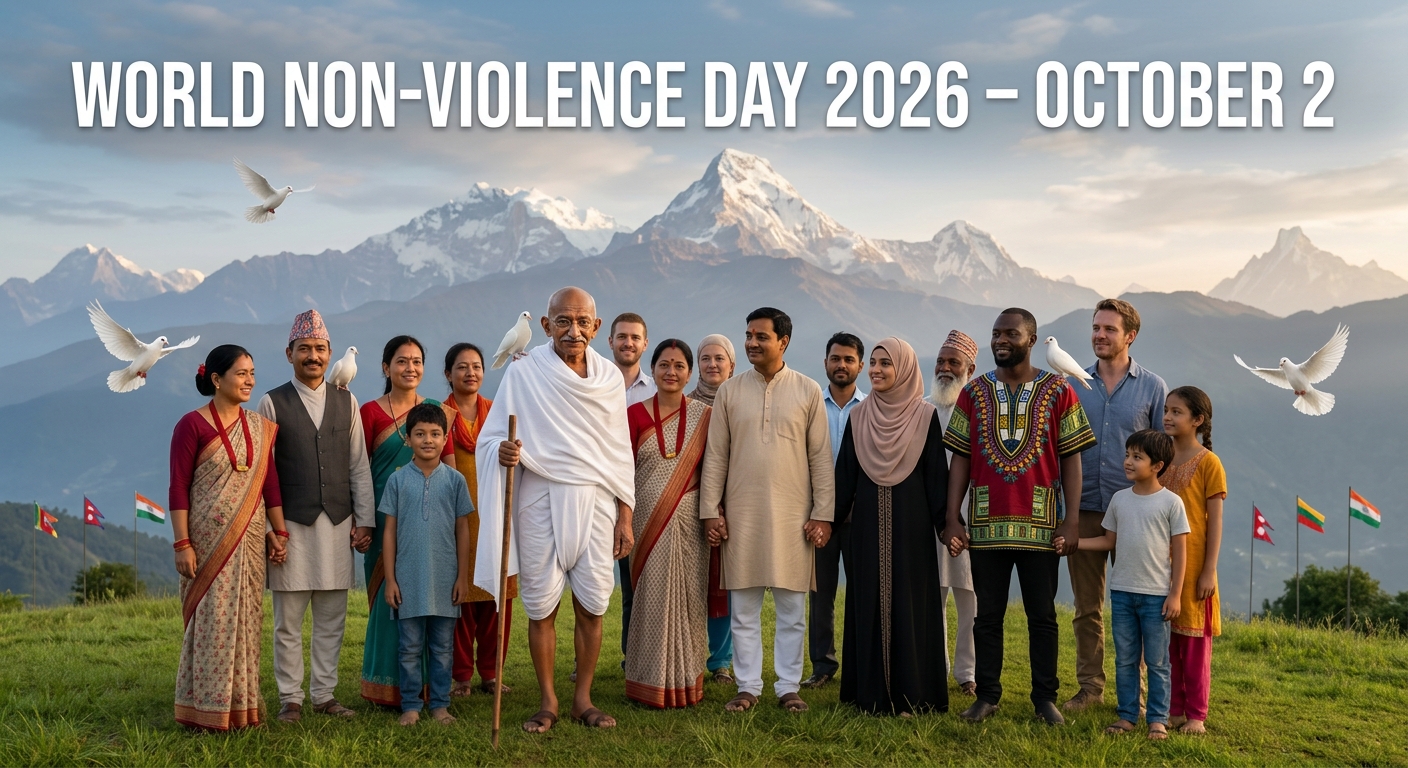
World Non-Violence Day: Promoting Peace and Humanity
Violence is not always about physical harm. Harsh words, bullying, discrimination, hatred, and online abuse can also hurt people and damage relationships. In a world where conflicts and misunderstandings are common, peace and non-violence are more important than ever.
World Non-Violence Day, also known as the International Day of Non-Violence, is observed every year on October 2. The day marks the birth anniversary of Mahatma Gandhi, the leader who inspired millions through his philosophy of truth, peace, and non-violent resistance.
The day reminds people around the world that we can solve many problems through dialogue, understanding, and mutual respect instead of violence.
When Is World Non-Violence Day 2026?
World Non-Violence Day 2026 will be observed on Friday, October 2, 2026.
The United Nations established the International Day of Non-Violence in 2007 to spread awareness about non-violence through education and public awareness. The date was chosen to honor Mahatma Gandhi, whose life and philosophy influenced peaceful movements worldwide.
History of World Non-Violence Day
The United Nations General Assembly adopted Resolution 61/271 on June 15, 2007, establishing the International Day of Non-Violence.
The initiative recognized the importance of Gandhi’s principles and their relevance to building a peaceful world.
Mahatma Gandhi played a major role in India’s struggle for independence from British colonial rule. Rather than relying on armed resistance, he promoted Satyagraha, a philosophy based on truth, non-violent resistance, and moral courage.
His ideas later influenced leaders such as Martin Luther King Jr. and Nelson Mandela, who became associated with movements for civil rights, equality, and freedom.
Today, the observance encourages individuals, communities, governments, and organizations to reject violence and work toward peaceful solutions.
Why Is World Non-Violence Day Important?
World Non-Violence Day is more than a date on the calendar. It encourages people to reflect on their behavior and consider how their actions affect others.
1. Promotes Peace and Understanding
Peaceful communication helps people resolve disagreements without creating unnecessary conflict. Listening to different opinions can build trust and strengthen relationships.
2. Encourages Equality and Human Rights
Violence and discrimination often affect vulnerable communities. Promoting non-violence supports dignity, equal opportunities, and respect for human rights.
3. Raises Awareness About Bullying
Bullying can happen in schools, workplaces, and online communities. This day encourages people to speak against harassment and support those who experience it.
4. Inspires Young People
Children and young adults can help create a peaceful society by practicing kindness, respecting differences, and learning to manage disagreements constructively.
5. Supports Peaceful Conflict Resolution
From family disagreements to international conflicts, dialogue and negotiation can offer alternatives to violence and help prevent further harm.
Mahatma Gandhi and the Philosophy of Non-Violence
Mahatma Gandhi believed that non-violence was a powerful way to challenge injustice without responding with hatred.
His philosophy was not simply about avoiding physical force. It also emphasized truth, compassion, self-discipline, and respect for human dignity.
Gandhi demonstrated these principles through India’s independence movement, including the famous Salt March of 1930, which challenged British colonial salt laws through peaceful protest.
His legacy continues to inspire people who believe that lasting change can be achieved through courage, unity, and peaceful action.
How Can We Celebrate World Non-Violence Day?
Everyone can contribute to a more peaceful world. You do not need to organize a major event to make a difference.
Here are some simple ways to observe the day:
- Practice kindness: Treat family members, friends, colleagues, and strangers with respect.
- Reject bullying: Support people who face harassment or discrimination.
- Promote peaceful communication: Listen carefully and avoid responding to anger with more anger.
- Spread awareness: Share educational messages about peace and non-violence on social media.
- Organize school activities: Participate in essay competitions, debates, speeches, or poster-making events about peace.
- Respect differences: Accept that people may have different cultures, beliefs, backgrounds, and opinions.
- Resolve conflicts peacefully: Use discussion, mediation, and cooperation whenever possible.
Small actions can create meaningful change when practiced consistently.
World Non-Violence Day in Nepal
In Nepal, the message of non-violence is particularly relevant to families, schools, communities, and public life.
Nepal is home to diverse cultures, languages, traditions, and religious communities. Respecting this diversity and encouraging peaceful dialogue can help strengthen social harmony.
Schools and colleges can observe the day through speeches, awareness programs, essay competitions, and discussions about peaceful conflict resolution.
Families can also teach children to solve disagreements without hitting, threatening, or insulting others. Online users can contribute by avoiding cyberbullying, misinformation, and hateful comments.
By practicing these values in everyday life, Nepali communities can help build a safer and more respectful society.
Difference Between Non-Violence and Passive Behavior
Non-violence does not mean remaining silent when someone faces injustice. It means standing against wrongdoing without using unnecessary violence.
People can peacefully protest, report abuse, support victims, demand accountability, and defend human rights.
Non-violent action can be firm and courageous. Its purpose is to challenge harmful behavior while respecting human dignity and seeking constructive change.
Frequently Asked Questions (FAQs)
1. When is World Non-Violence Day celebrated?
World Non-Violence Day is observed every year on October 2, the birth anniversary of Mahatma Gandhi. In 2026, it falls on Friday.
2. Who started World Non-Violence Day?
The United Nations General Assembly established the International Day of Non-Violence in 2007 through Resolution 61/271.
3. What is the main message of World Non-Violence Day?
Its main message is to promote peace, truth, tolerance, equality, and peaceful ways of resolving conflicts. It encourages people to reject violence and treat others with dignity.
Conclusion
World Non-Violence Day reminds us that peace begins with our everyday choices. The way we speak, respond to disagreements, treat vulnerable people, and respect different opinions can influence the world around us.
Mahatma Gandhi’s legacy teaches us that courage does not always require force. Sometimes, the strongest response to hatred is peaceful action guided by truth and compassion.
On October 2, let us renew our commitment to kindness, respect, and peaceful solutions. A better world begins when each of us takes responsibility for our actions.
What does non-violence mean to you? Share your thoughts in the comments, share this article with your friends, and subscribe to our website for more informative articles about important days and global events.