
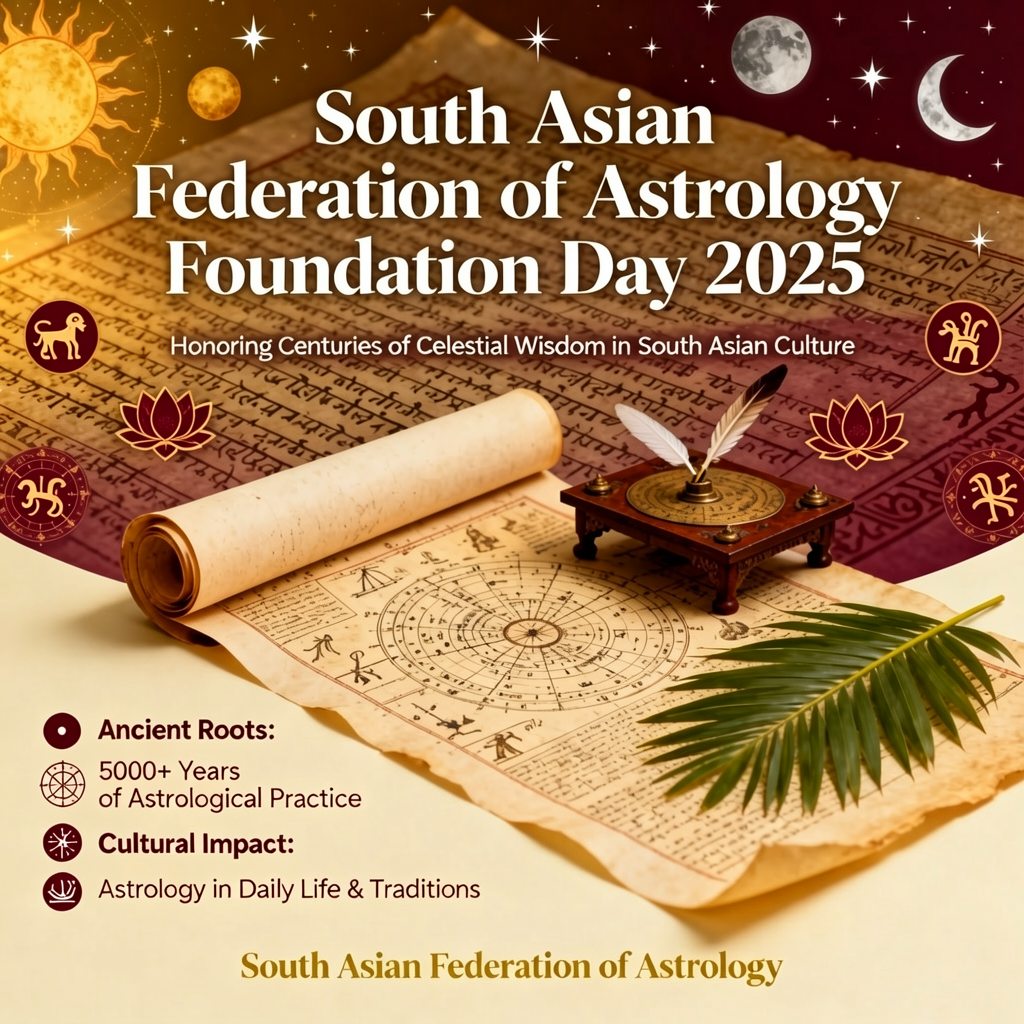
South Asian Federation of Astrology Foundation Day — Celebrating the Ancient Science That Has Guided Millions for Thousands of Years
Long before GPS told us where to go —
Long before clocks told us when to wake up —
Long before calendars told us what day it was —
There were the stars.
Our ancestors looked up at the night sky and saw not just light — but a language. A divine map. A guide for understanding human life, relationships, health, career, and destiny.
This ancient science — Jyotish Vidya (ज्योतिष विद्या) — has been practised across South Asia for over 5,000 years.
And the South Asian Federation of Astrology (SAFA) exists to honour, protect, promote, and advance this incredible tradition in the modern world.
Its Foundation Day is a celebration of that mission — and of astrology’s enduring relevance in the lives of millions of people across Nepal, India, Sri Lanka, Bangladesh, Bhutan, and beyond.
What Is the South Asian Federation of Astrology (SAFA)?
The South Asian Federation of Astrology (SAFA) is a regional organisation dedicated to the promotion, research, standardisation, and education of Vedic and traditional astrology across South Asian nations.
SAFA brings together professional astrologers, researchers, scholars, educators, and enthusiasts from across the region under one collective platform. Its core mission is:
- ✅ To preserve the ancient knowledge of Jyotish (Vedic Astrology)
- ✅ To promote scientific research and scholarly study of astrological traditions
- ✅ To create educational standards and certification for practising astrologers
- ✅ To foster regional cooperation and knowledge-sharing among South Asian nations
- ✅ To bridge the gap between traditional astrology and the modern world
SAFA recognises that astrology in South Asia is not merely a belief system — it is a living cultural institution deeply woven into daily life, religious ceremonies, marriage customs, naming traditions, and national calendars.
Foundation Day — A Celebration of Jyotish Vidya
SAFA Foundation Day marks the anniversary of the establishment of the South Asian Federation of Astrology. It is observed annually as a day of:
- 🎓 Academic seminars and lectures on Vedic astrology, astronomical science, and related disciplines
- 📜 Recognition of master astrologers who have made outstanding contributions to the field
- 🌏 Regional cooperation — astrologers from Nepal, India, Sri Lanka, Bangladesh, and other South Asian nations come together to exchange knowledge
- 📚 Publication of research — new findings in astrological science, ephemeris data, and traditional texts
- 🙏 Cultural programmes celebrating the rich heritage of South Asian astrological traditions
The Foundation Day is not just an organisational anniversary — it is a statement to the world that Jyotish Vidya is alive, relevant, and deserving of serious scholarly attention.
The Ancient Roots of Astrology in South Asia — A History Spanning 5,000 Years
To understand SAFA, you must first understand the extraordinary depth of astrology’s history in South Asia.
The Vedic Origins — 3000 BCE and Beyond
Vedic Astrology, known as Jyotish (ज्योतिष) — literally meaning “the science of light” — is one of the six Vedangas, the auxiliary disciplines of the ancient Vedas.
The earliest astrological references appear in the Rigveda — one of the oldest known texts in human history, dated to approximately 1500–1200 BCE, though oral traditions go back even further to around 3000 BCE.
The ancient Indian astronomer and mathematician Aryabhata (476–550 CE) made groundbreaking contributions to astronomical science that directly informed astrological practice — including calculating the Earth’s rotation, the causes of solar and lunar eclipses, and the approximate circumference of the Earth — over 1,000 years before European scientists arrived at similar conclusions.
The Pancha Siddhantika — The Five Astronomical Treatises
Around 505 CE, the great scholar Varahamihira compiled the Pancha Siddhantika — five major astronomical and astrological treatises that summarised the state of Indian astronomical knowledge at the time. His work Brihat Jataka remains one of the most authoritative texts in Vedic astrology to this day.
Astrology in Nepal — Thousands of Years of Living Tradition
In Nepal, astrology has never been merely academic — it is woven into the fabric of daily life.
- 👶 Every child born in a Hindu family receives a Janmapatri (birth chart / kundali) — cast by a family astrologer (Jyotishi) to determine auspicious naming, future challenges, and life path
- 💍 Marriage matching (Kundali Milan) is considered essential in most Hindu families across Nepal — two charts are compared across 36 compatibility points (Gunas)
- 📅 Nepal’s official Bikram Sambat calendar is itself a product of astrological computation — determining auspicious dates (Shubha Muhurta) for festivals, rituals, and national events
- 🏛️ Major national events — from temple consecrations to the inauguration of government buildings — are still timed according to Muhurta (astrologically auspicious timing)
- 🌙 The Panchanga (Nepali almanac) — consulted by millions — is a sophisticated astrological document calculating lunar days (Tithi), constellations (Nakshatra), planetary positions, and auspicious times for every day of the year
Fascinating Facts About Vedic Astrology and South Asian Astrological Tradition
Here are facts that will genuinely surprise you:
- ⭐ Vedic astrology uses 27 Nakshatras (lunar mansions) — a system of mapping the sky that predates Western zodiac signs by centuries
- 🪐 Traditional Jyotish recognises 9 celestial bodies (Navagrahas) — Sun, Moon, Mars, Mercury, Jupiter, Venus, Saturn, Rahu, and Ketu — with Rahu and Ketu being the lunar nodes, unique to Vedic tradition
- 🔢 The Ashtakavarga system — a complex mathematical method of evaluating planetary strengths — was developed in ancient India and has no equivalent in Western astrology
- 📖 The Brihat Parashara Hora Shastra — attributed to the sage Parashara — is considered the foundational text of Vedic astrology and contains over 100 chapters of detailed astrological principles
- 🌍 Vedic astrology uses the Sidereal zodiac (based on actual star positions) while Western astrology uses the Tropical zodiac (based on seasons) — a difference of approximately 23 degrees, which is why your Western sun sign and Vedic sun sign are often different
- 🏫 Several Indian universities — including Banaras Hindu University (BHU) — offer postgraduate degrees in Jyotish, recognising it as a formal academic discipline
- 🇳🇵 In Nepal, the Panchanga (astrological almanac) is officially used by the government to determine public holidays, festival dates, and national events — making astrology literally a matter of national policy
- 🌟 The ancient Indian concept of Dashas (planetary periods) — a system for predicting life events based on the ruling planet at birth — is considered one of the most sophisticated predictive tools in any astrological tradition worldwide
- 💫 Kumbh Mela — the world’s largest human gathering, attended by over 120 million people in 2019 — is entirely timed according to Vedic astrological calculations of planetary positions
- 📿 The Navagraha temples of South India form one of the world’s most unique temple circuits — nine temples, each dedicated to one of the nine celestial bodies of Vedic astrology, spread across Tamil Nadu
Why SAFA Matters in the Modern World
In an age of smartphones and satellites, does astrology still have a place?
For hundreds of millions of people across South Asia — the answer is an unambiguous yes.
But SAFA’s work goes beyond simply defending astrology against scepticism. The federation recognises several critical modern challenges:
1. Standardisation of Practice With millions of astrologers practising across South Asia — many self-taught, some deeply knowledgeable, others less so — there is a pressing need for ethical standards, educational benchmarks, and professional accountability. SAFA works to establish these.
2. Preservation of Ancient Texts Thousands of astrological manuscripts in Sanskrit, Nepali, Tamil, and other South Asian languages remain untranslated, undigitised, and at risk of being lost forever. SAFA supports efforts to document and preserve this priceless textual heritage.
3. Bridging Tradition and Technology Modern astronomy and data science offer powerful new tools for astrological research. SAFA encourages astrologers to embrace these tools while remaining grounded in traditional wisdom.
4. Regional Unity South Asia is a region of enormous cultural diversity — but also profound shared heritage. Astrology is one of the few traditions that cuts across national borders, languages, and even religions across the region. SAFA celebrates and strengthens this shared identity.
Astrology in Nepali Culture — More Than Just Horoscopes
For many people outside South Asia, astrology means a daily horoscope column in a newspaper. In Nepal, it means something far deeper.
Consider these everyday moments where astrology plays a central role in Nepali life:
- 🍚 Pasni (Rice Feeding Ceremony) — the auspicious date for a baby’s first rice feeding is determined by an astrologer
- ✂️ Chudakarana (Head Shaving Ceremony) — timed according to the child’s astrological chart
- 🏠 Griha Pravesha (Housewarming) — families consult a Jyotishi to determine the most auspicious time to enter a new home
- 🌾 Agricultural timing — even today, many Nepali farmers consult the Panchanga to determine the best time to plant and harvest
- 💼 Starting a new business — the Muhurta (auspicious moment) for opening a shop or signing a contract is still widely observed
- 🕌 Temple consecration (Pratishtha) — no temple in Nepal is consecrated without precise astrological timing
This is not superstition — it is a living cultural system that has maintained social cohesion, marked life transitions, and connected communities to cosmic cycles for millennia.
(👉 Related Post: [Understanding the Nepali Panchanga — Your Complete Guide to Nepal’s Astrological Calendar])
How to Observe SAFA Foundation Day
Whether you are an astrology practitioner or simply a curious learner, here is how you can mark this day meaningfully:
- 📚 Read a book on Vedic astrology — start with beginner-friendly texts on Jyotish fundamentals
- 🔭 Look at the night sky — identify the visible planets and constellations. Our ancestors did this without any technology
- 🧘 Learn about your Janma Nakshatra — your birth star in Vedic tradition. It reveals fascinating insights about your personality and life path
- 🎙️ Attend a seminar or webinar — many astrology organisations host online events on Foundation Day
- 📝 Get your Kundali analysed — visit a professional Jyotishi and explore what your birth chart reveals
- 🌐 Share knowledge — post about the richness of Vedic astrology on social media and help preserve this tradition for the next generation
Conclusion — The Stars Have Always Been Watching
For five thousand years, the people of South Asia have looked up at the same stars.
They built temples aligned with celestial movements. They timed their harvests, their weddings, their journeys by the movement of planets and the phases of the moon. They developed one of the most sophisticated mathematical and astronomical traditions in human history — and called it Jyotish — the science of light.
The South Asian Federation of Astrology carries that light forward.
On its Foundation Day, we celebrate not just an organisation — but a living tradition that has guided, comforted, and connected millions of people across generations, cultures, and borders.
The stars have always been watching.
And thanks to SAFA — we have never stopped watching back.
Share this post with every astrology lover, every proud South Asian, and everyone who has ever looked up at the night sky and felt something beyond words. ⭐🙏
Do you consult a Jyotishi or check your Panchanga regularly? What role does astrology play in your family’s life? Share your story in the comments below!
FAQ — Frequently Asked Questions About SAFA Foundation Day
Q1: What is the South Asian Federation of Astrology (SAFA)? The South Asian Federation of Astrology (SAFA) is a regional organisation that promotes, preserves, and advances the study and practice of Vedic and traditional astrology across South Asian countries including Nepal, India, Sri Lanka, Bangladesh, and Bhutan. It brings together professional astrologers, scholars, and researchers under one platform to foster education, research, and regional cooperation in the field of Jyotish.
Q2: What is Vedic Astrology and how is it different from Western astrology? Vedic Astrology (Jyotish) is an ancient Indian astrological system with roots going back over 5,000 years. It differs from Western astrology primarily in its use of the Sidereal zodiac (based on actual star positions) versus the Western Tropical zodiac (based on seasons). Vedic astrology also uses a unique system of 27 lunar mansions (Nakshatras), 9 celestial bodies (Navagrahas including Rahu and Ketu), and predictive tools like the Dasha system that have no direct equivalent in Western traditions.
Q3: Is astrology officially recognised in Nepal and other South Asian countries? Yes — in a significant way. Nepal’s official Bikram Sambat calendar (the national calendar used for all government and legal purposes) is based on astrological calculations. The Panchanga — a sophisticated astrological almanac — is used to determine public holidays and festival dates at the national level. In India, several universities including Banaras Hindu University offer postgraduate degrees in Jyotish, giving it formal academic recognition.
Sources: International Association for Vedic Astrology | UNESCO Intangible Cultural Heritage — Vedic Chanting | Banaras Hindu University — Jyotish Department | Nepal Rastriya Panchanga