
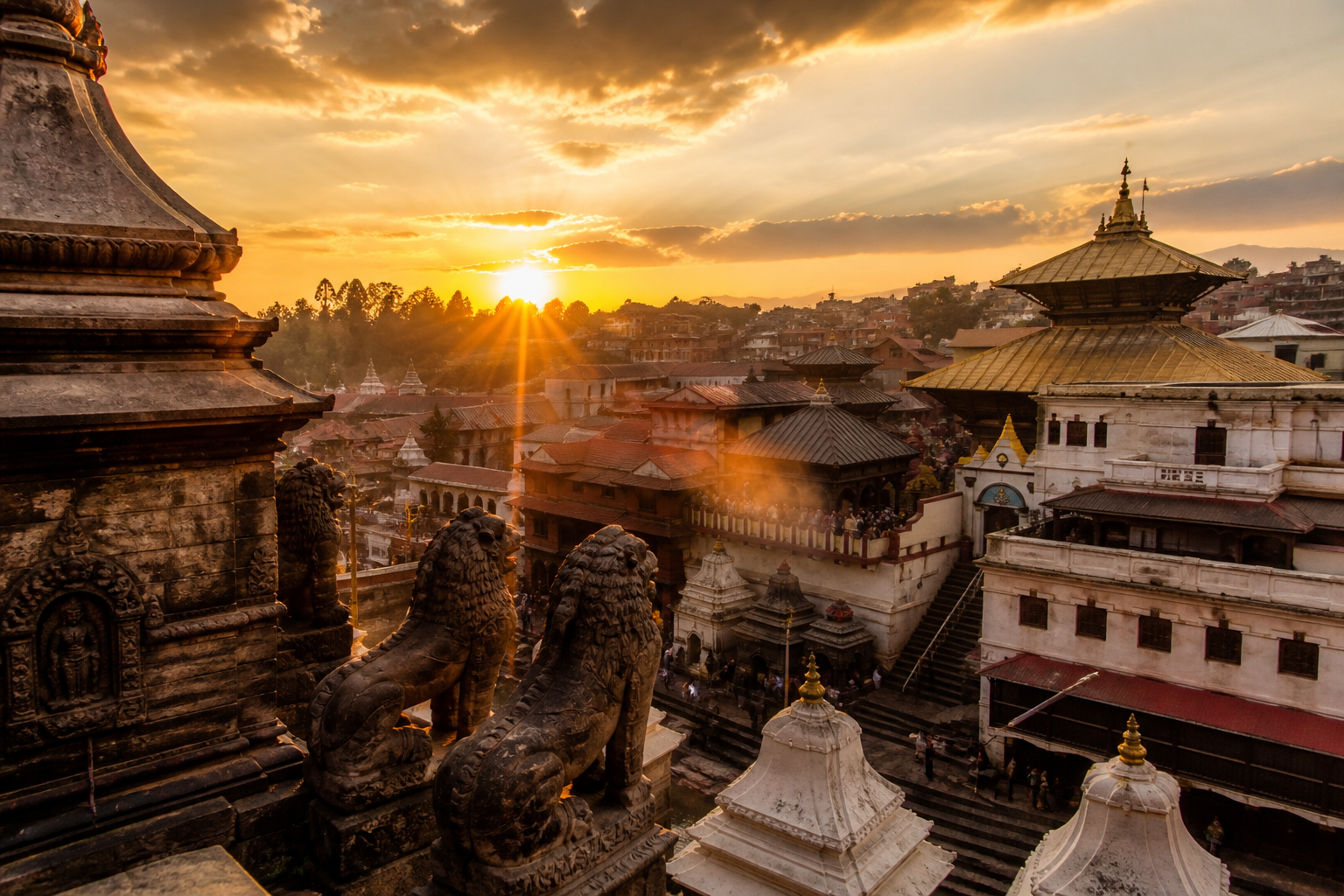
International Day for Monuments and Sites — Protecting the Stories Written in Stone
Close your eyes for a moment.
Imagine standing in front of the Pashupatinath Temple in Kathmandu. The smell of incense drifts through the air. Stone carvings centuries old surround you. Pilgrims chant ancient prayers. The Bagmati River flows quietly below.
Now imagine that one day — it is simply gone.
No earthquake warning. No war. Just decades of neglect, unplanned development, and indifference.
This is not a hypothetical fear. It is a reality that threatens thousands of monuments and heritage sites around the world every single year.
International Day for Monuments and Sites — observed every year on April 18 — exists to ensure we never let that happen.
What Is International Day for Monuments and Sites?
International Day for Monuments and Sites, also widely known as World Heritage Day, is a globally observed occasion dedicated to raising awareness about the diversity of cultural heritage and the efforts required to protect and conserve it.
It is a day for governments, organisations, communities, and individuals to reflect on what we stand to lose — and what we must do to protect the monuments, sites, and places that connect us to our shared human history.
Every year, hundreds of events take place worldwide — free guided tours of heritage sites, photography exhibitions, conservation workshops, school programmes, and public lectures — all aimed at deepening our appreciation for the world’s cultural treasures.
The day carries a different theme each year, chosen to highlight a specific challenge or dimension of heritage conservation.
When Did It Start? The Full History of World Heritage Day
The Birth of the Idea — 1982, Tunisia
International Day for Monuments and Sites was founded by the International Council on Monuments and Sites (ICOMOS) — the world’s leading non-governmental organisation dedicated to the conservation of cultural heritage.
The idea was first proposed at the ICOMOS symposium held in Tunisia on April 18, 1982. The proposal was simple but powerful: dedicate one day every year to drawing global attention to the importance of cultural heritage and its conservation.
The date April 18 was chosen to mark this founding symposium — and it has been observed every year since.
UNESCO’s Official Endorsement — 1983
Just one year later, in 1983, the UNESCO General Conference officially endorsed International Day for Monuments and Sites, giving it global legitimacy and institutional backing.
With UNESCO’s support, the day transformed from a professional industry initiative into a worldwide public movement, now observed in over 100 countries across six continents.
What Is ICOMOS?
ICOMOS — the International Council on Monuments and Sites — was founded in 1965 in Warsaw, Poland, following the adoption of the Venice Charter (1964), the foundational international document on the conservation and restoration of monuments and sites.
Today, ICOMOS has members in over 150 countries and serves as the official advisory body to UNESCO on World Heritage matters. When UNESCO evaluates whether a site deserves World Heritage status, it is ICOMOS that conducts the technical assessment.
Think of ICOMOS as the world’s foremost guardian of human memory written in stone, brick, wood, and earth.
Fascinating Facts About Monuments and Heritage Sites
This is where it gets really interesting. Here are facts that most people never know:
- 🌍 There are currently 1,223 UNESCO World Heritage Sites across 168 countries (as of 2024) — including 952 cultural, 231 natural, and 40 mixed sites
- 🇳🇵 Nepal alone has 8 UNESCO World Heritage Sites — 4 cultural and 4 natural — making it one of the most heritage-rich small nations on earth
- ⏳ The oldest known monument in the world is Göbekli Tepe in Turkey, dating back approximately 12,000 years — built before the invention of writing or the wheel
- 🏛️ The Great Wall of China stretches over 21,000 kilometres — making it the longest monument ever built by human hands
- 💧 Venice, Italy — a UNESCO World Heritage Site — is sinking at a rate of 1–2 millimetres per year due to climate change and rising sea levels, putting its entire existence at risk
- 🔥 In 2019, a devastating fire damaged the Notre-Dame Cathedral in Paris — a monument that had stood for over 850 years. Its near-destruction shocked the world into recognising how fragile even our greatest monuments are
- 🗿 The Moai statues of Easter Island — some weighing over 80 tonnes — were carved between the 13th and 16th centuries. How they were moved remains one of history’s greatest mysteries
- 📉 According to UNESCO, one cultural heritage site is lost or seriously damaged every single day somewhere in the world
- 🏔️ Machu Picchu in Peru receives over 1.5 million visitors per year — so many that UNESCO has raised serious concerns about overtourism damaging the site
- 💣 Armed conflict is one of the leading causes of heritage destruction — the ancient city of Palmyra in Syria and Timbuktu in Mali suffered catastrophic damage in recent conflicts
- 🌡️ Climate change is now considered the single biggest long-term threat to World Heritage Sites globally, affecting everything from coastal monuments to fragile rock art in deserts
- 🧱 The Colosseum in Rome was used as a quarry for centuries after the fall of the Roman Empire — nearly two-thirds of its original material was stripped away before conservation efforts began
Nepal’s Heritage — A Treasure We Must Protect
Nepal is not just a country of mountains. It is a country of living history carved in stone, wood, and faith.
Nepal’s 8 UNESCO World Heritage Sites
Cultural Sites:
- 🏛️ Kathmandu Valley — including Pashupatinath Temple, Boudhanath Stupa, Swayambhunath, Changu Narayan, and the three Durbar Squares of Kathmandu, Patan, and Bhaktapur
- ☸️ Lumbini — the birthplace of Lord Buddha, one of the most sacred sites in the world
- 🏰 Chitwan National Park — (natural heritage) home to one-horned rhinos and Bengal tigers
Natural Sites:
- 🏔️ Sagarmatha National Park — home to Mount Everest, the world’s highest peak
- 🌿 Chitwan National Park
- 🦏 Bardiya National Park area (buffer zones recognised)
The 2015 Earthquake — A Wake-Up Call
The devastating 2015 Gorkha Earthquake (magnitude 7.8) caused catastrophic damage to Nepal’s heritage sites.
The Dharahara Tower collapsed entirely. Kasthamandap — believed to be one of the oldest wooden buildings in the world — was destroyed. Dozens of temples in Bhaktapur, Patan, and Kathmandu’s Durbar Squares were severely damaged.
The earthquake was a painful reminder that heritage conservation is not a luxury — it is an urgent necessity.
The rebuilding process, supported by UNESCO and international partners, is still ongoing. Some temples have been restored. Others remain in scaffolding. A few are gone forever.
This is why International Day for Monuments and Sites matters so deeply to Nepal.
Themes of International Day for Monuments and Sites — Past and Present
Each year, ICOMOS announces a unique theme. Here are some notable ones:
| Year | Theme |
|---|---|
| 2025 | Heritage and Climate — Addressing climate threats to cultural sites |
| 2024 | Disasters & Conflicts Through the Lens of the Venice Charter |
| 2023 | Heritage Changes |
| 2022 | Heritage and Climate |
| 2021 | Complex Pasts: Diverse Futures |
| 2020 | Shared Cultures, Shared Heritage, Shared Responsibility |
| 2019 | Rural Landscapes |
| 2018 | Heritage for Generations |
Each theme reflects the evolving challenges that heritage sites face — from climate change and natural disasters to social conflict and the need for inclusive conservation.
Why Does Heritage Conservation Matter in 2025?
Some people ask — why spend money conserving old buildings when we have so many modern problems to solve?
The answer is profound.
Heritage sites are not just old buildings. They are:
- 📖 Living textbooks — Every temple carving, every ancient inscription, every architectural detail tells us who we were and how we thought
- 💼 Economic engines — Heritage tourism generates billions of dollars globally every year and supports millions of livelihoods. In Nepal, heritage tourism is one of the top sources of foreign exchange
- 🧠 Anchors of identity — Communities that lose their heritage lose a part of their identity. Studies show that cultural heritage is directly linked to social cohesion and mental wellbeing
- 🌱 Sustainable resources — Unlike oil or minerals, properly conserved heritage sites can generate income for communities indefinitely without being depleted
- 🤝 Bridges between peoples — Shared heritage creates understanding between nations, religions, and cultures. The Lumbini peace park, for example, attracts pilgrims from 160 countries
When we lose a monument, we lose a piece of our collective memory — a piece that can never be replaced.
How Can You Participate in International Day for Monuments and Sites 2025?
You don’t need to be an archaeologist or conservationist. Here is what anyone can do:
- 🏛️ Visit a local heritage site — Nepal has thousands. Go to your nearest temple, stupa, or historic building and truly look at it
- 📸 Document and share — Take photos of local monuments and share on social media with #WorldHeritageDay and #April18
- 📚 Learn the history — Read about a monument in your district. Knowledge is the first step to conservation
- 🗣️ Speak up — If you see illegal construction near a heritage site, report it to your local municipality or the Department of Archaeology, Nepal
- 🧹 Join a clean-up drive — Many local organisations organise heritage site clean-up events on April 18
- 👶 Teach the next generation — Tell children about the stories behind local temples and monuments. Heritage lives on through people, not just stone
- 💰 Support heritage conservation organisations — Even small donations to local heritage trusts make a real difference
Conclusion — Our Heritage Is Our Responsibility
Every stone in Pashupatinath. Every brick in Bhaktapur Durbar Square. Every carved window in Patan. Every prayer flag around Boudhanath.
These are not just tourist attractions. They are our inheritance — passed down to us by generations of ancestors who built them with their hands, their faith, and their love for something greater than themselves.
International Day for Monuments and Sites is the world’s annual promise to those ancestors: We will not forget. We will not neglect. We will protect.
On April 18, take a moment to visit, appreciate, and share the heritage around you.
Because the greatest threat to our monuments is not earthquakes or floods — it is indifference.
Share this post with every Nepali who is proud of our culture and history. 🏛️🙏
Which heritage site in Nepal is closest to your heart? Tell us in the comments below — and let’s celebrate our shared history together!
FAQ — Frequently Asked Questions About International Day for Monuments and Sites
Q1: When is International Day for Monuments and Sites celebrated? International Day for Monuments and Sites is celebrated every year on April 18. The date was chosen to mark the founding ICOMOS symposium held in Tunisia on April 18, 1982. It has been officially endorsed by UNESCO since 1983 and is now observed in over 100 countries worldwide.
Q2: What is the difference between International Day for Monuments and Sites and World Heritage Day? They are the same day! International Day for Monuments and Sites is the official name given by ICOMOS and UNESCO, while World Heritage Day is the popular name used by the general public and media. Both refer to the global observance on April 18 dedicated to cultural heritage conservation.
Q3: How many UNESCO World Heritage Sites does Nepal have? Nepal has 8 UNESCO World Heritage Sites — 4 cultural and 4 natural. The cultural sites include the Kathmandu Valley (with its seven monument zones including Pashupatinath, Boudhanath, Swayambhunath, and the three Durbar Squares) and Lumbini, the birthplace of Buddha. The natural sites include Sagarmatha National Park (home to Mount Everest) and Chitwan National Park.
Sources: ICOMOS Official Website | UNESCO World Heritage | Department of Archaeology, Nepal | UNESCO Nepal