


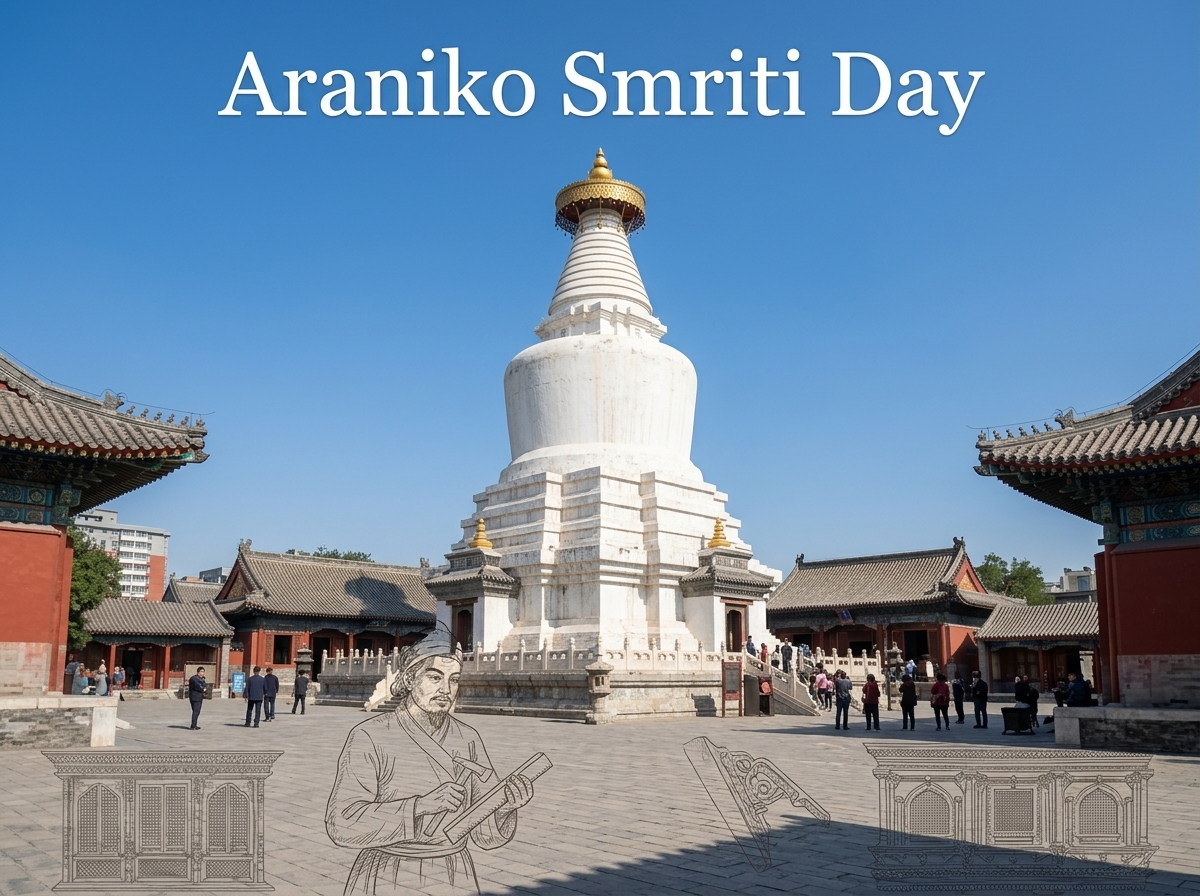
Araniko Smriti Day: Remembering Nepal’s Legendary Artist
Nepal has a rich history of art, architecture, and craftsmanship. Among the people who helped introduce Nepali artistic traditions to the world, Araniko holds a special place. His extraordinary skills in sculpture and architecture earned him recognition in China and made him an important figure in Nepal’s cultural history.
Araniko Smriti Day is observed to remember his achievements and honour his contribution to art, architecture, and cultural exchange. The day also reminds us that Nepali talent has influenced communities beyond the country’s borders for centuries.
When Is Araniko Smriti Day Observed?
Araniko Smriti Day is observed in Nepal on Poush 23 of the Nepali calendar, according to reports about the annual observance. The corresponding Gregorian date changes each year.
The day honours Araniko, a celebrated Nepali artist and architect whose work became well known during China’s Yuan dynasty. Nepal’s art community has played an important role in promoting his memory and legacy.
Who Was Araniko?
Araniko, also spelled Arniko, was a skilled artist and architect born in Nepal in the 13th century. Historical accounts commonly place his birth around 1244 or 1245, although details of his early life remain uncertain.
He travelled to Tibet and later worked in China under the Yuan dynasty, which was established by Kublai Khan. There, he became known for his ability to design buildings, create sculptures, and produce religious artwork.
Araniko spent much of his life outside Nepal, but his achievements helped bring recognition to Nepali art and craftsmanship. He is remembered as a cultural link between Nepal, Tibet, and China.
Araniko’s Most Famous Achievement: The White Stupa
One of Araniko’s best-known works is the White Stupa, also called the White Dagoba, at Miaoying Temple in Beijing, China.
The striking white structure is an important example of Buddhist architecture and reflects the artistic exchange that took place across the Himalayan region. Araniko is widely associated with its construction during the 13th century.
His work went beyond architecture. Historical accounts also credit him with creating statues, religious images, and other artistic objects. He helped train craftsmen and artists, allowing artistic knowledge to pass between generations and cultures.
The White Stupa remains a powerful reminder of the long cultural relationship between Nepal and China.
Why Is Araniko Smriti Day Important?
Araniko’s legacy is not limited to a single monument. His life highlights the value of creativity, skill, cultural exchange, and international cooperation.
1. Preserving Nepal’s artistic heritage
The day encourages people to learn about Nepal’s traditional architecture, sculpture, painting, and craftsmanship. Remembering artists like Araniko helps keep this heritage alive.
2. Promoting Nepal-China friendship
Araniko’s work in China represents centuries of cultural contact between the two countries. His legacy shows how art can build connections across borders.
3. Inspiring young artists
His achievements remind students and young creators that dedication and skill can open doors around the world. Artists, architects, sculptors, and designers can draw inspiration from his life.
4. Recognizing Nepali talent worldwide
Araniko demonstrates that Nepali artists have contributed to international art and architecture for centuries. His story encourages Nepal to document, preserve, and promote its cultural achievements.
How Is Araniko Smriti Day Celebrated?
The day can be marked through educational, cultural, and artistic activities. Schools, colleges, cultural organizations, and art institutions can help introduce Araniko’s achievements to new generations.
Some meaningful ways to observe the day include:
- Learning about his life: Read books and articles about Araniko and his artistic achievements.
- Organizing art exhibitions: Display traditional Nepali sculpture, painting, and architectural designs.
- Visiting heritage sites: Explore historic temples, stupas, and monuments in Nepal.
- Holding school programmes: Encourage students to prepare essays, speeches, drawings, and presentations about Araniko.
- Promoting traditional artists: Support local sculptors, painters, woodcarvers, and craftspeople.
- Sharing his story online: Publish informative posts and photographs to raise awareness of Nepal’s artistic heritage.
These activities help transform remembrance into practical support for Nepal’s creative community.
Lessons We Can Learn from Araniko
Araniko’s story offers several valuable lessons for modern Nepal:
- Develop your skills: Consistent learning and practice can lead to remarkable achievements.
- Respect cultural diversity: Art can connect people from different countries and traditions.
- Preserve traditional knowledge: Ancient skills deserve documentation, appreciation, and continued practice.
- Represent your country with pride: Excellence in your work can help others understand and appreciate your culture.
- Pass knowledge to future generations: Teaching others helps valuable traditions survive.
Frequently Asked Questions (FAQs)
1. When is Araniko Smriti Day celebrated in Nepal?
Araniko Smriti Day is observed on Poush 23 in the Nepali calendar. The corresponding English date changes every year.
2. Who was Araniko?
Araniko was a renowned Nepali artist and architect of the 13th century who worked in Tibet and China. He is especially known for his association with the White Stupa in Beijing.
3. Why is Araniko famous in China?
Araniko gained recognition for his architectural and artistic skills during the Yuan dynasty. His work, particularly the White Stupa at Miaoying Temple, remains an important part of his legacy.
Conclusion
Araniko Smriti Day is an opportunity to celebrate one of Nepal’s most remarkable artistic figures. Through his architecture, sculpture, and cultural influence, Araniko helped share Nepali artistic traditions with the wider world.
Remembering him is also a reminder to protect Nepal’s heritage, encourage young artists, and appreciate the power of cultural exchange.
Have you visited a historic monument or seen traditional Nepali artwork that inspires you? Share your experience in the comments and share this article to help more people discover Araniko’s legacy.


